
Click on the sites below and explore Mackinac County!
Explore Mackinac County
Learn More
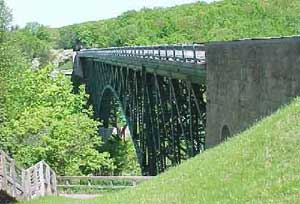
Cut River Bridge
This elaborate cantilever deck bridge is one of the U.P.'s largest and has served millions of automobiles since it opened in 1947. The bridge is 641 feet long and 147 feet above the Cut River. It is made up of 888 tons of steel. Construction of the bridge began in 1941, but was delayed due to the need for steel and workers during World War II. The bridge was designed by the Michigan State Highway department (now Department of Transportation) and built by W.J. Meager and Sons. It has been closed for repairs on several occasions over the years but is still a major attraction for visitors to the area. In addition to the bridge, there is a nature trail that goes down into the Cut River Valley and the shore of Lake Michigan.
Learn More
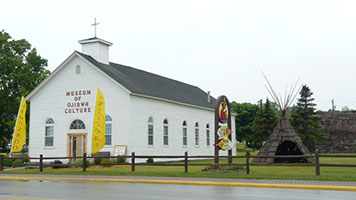
Father Marquette Park / Museum of Ojibwa Culture
In 1671, Father Jacques Marquette founded a mission near this site in what is now the village of St. Ignace. The town itself is named for the mission which took its name from the founder of the Jesuit order, St. Ignatius Loyola. After Father Marquette died along the shore of Lake Michigan in 1675, the mission continued until 1706 when it was closed. It was opened again 1712 and continued to serve the local community of native Americans and fur traders until 1741. Later, it was determined by archeological evidence that this site was the actual site of the mission. Father Jacques Marquette's bones had supposedly been recovered and then reburied on this site. To this day, it is unclear how accurate this work was but it is generally believed to be the site of mission. Today, the Museum of Ojibwa Culture occupies the former mission church which was built in 1837 on another site. It was moved here in 1905 and is believed to be the oldest church structure in Michigan. The Museum of Ojibwa Culture is an excellent small museum with displays on the lives of the native peoples who call this region home and the changes that contact with Europeans created in their culture.
Learn More
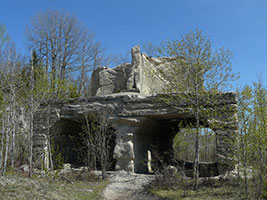
Fiborn Karst Preserve & Quarry
Located deep in the woods of Mackinac County is a fascinating and surprising landscape, quite unique in the Upper Peninsula. This region of the county has extremely pure limestone formations, known as Karst, which led to the development of limestone quarry from 1905 to 1936. This quarry supplied limestone for the Algoma Steel works in Sault Ste. Marie, Ontario. It was originally owned by Chase Osborn (Governor of Michigan, 1911 to 1913) and William Foresman Fitch, president of the Duluth, South Shore and Atlantic railroad. In 1913, the quarry was purchased by the Algoma Steel company. In 1987, the quarry and surrounding forest were purchased by the Michigan Karst Conservancy. The site now has walking trails both through the quarry and also in the woods surrounding the site. The quarry itself contains the ruins of several historic structures, some made from the quarry's limestone. The conservancy has several caves, one of which is the longest in Michigan.
Additional Information
- Tours of some of these caves can be arraigned through the Conservancy.
Learn More
- Visit the Michigan Karst Conservancy - Fiborn Karst Preserve website.
- View on Google Maps
Learn More
- Visit the Straits Cultural Center website.
- View on Google Maps
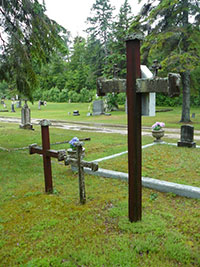
Gros Cap Cemetery
This small cemetery along U.S. 2 outside of St. Ignace, is actually much more than that. It also marks the location of a very large Ojibwa village along West Moran Bay which existed when the first French Voyageurs explored the region in the 1600s. This cemetery was the burial ground for that village and has continued to serve in that role right up to the present day for Ojibwa families, the families of the first European settlers and local residents. It is thought to be one of the oldest continually used cemeteries in the United States.
Additional Information
- The small cemetery is located along U.S. 2 outside of St. Ignace.
- It is open to the public but visitors are asked to be respectful of all gravesites and markers.
Learn More
Hessel Cemetery / Old Mission Indian Cemetery
For hundreds of years, the Sault Ste. Marie band of Chippewa Indians have been living in the Les Cheneux region. Alongside the Our Lady of the Snows Catholic Church in Hessel, several generations of Anishinaabeg people are buried in the Old Mission Indian Cemetery. The cemetery is maintained by the Native American Society for Historic Preservation and it is open to the public. The cemetery has over 100 known graves many with white wooden crosses. There is also an Anishinaabeg "spirit house," which were traditionally placed over burial sites.
Additional Information
- The cemetery is located in the village of Hessel at 261 South Island View Road.
Learn More
- Visit the Old Mission Indian Cemetery website.
- View on Google Maps
Les Cheneaux Historical Museum and Maritime Museum
In the village of Cedarville, the Les Cheneaux Historical Association manages two excellent museums that tell the fascinating history of the surrounding communities and the Les Cheneaux islands. The Historical Museum features the displays of artifacts showing many details from the past: Indian crafts and tools from the logging era, a model of a lumber camp, photos from frontier life of early settlers and hotel and tourist periods. The Maritime museum has model boats from the wooden boat era, a library, boating paraphernalia, a large collection of boats including and a Mackinaw boat. The museum also has a working boat building shop.
Additional Information
- The Historical Museum is on Meridian Road, one block south of the M-129 and 1-34 intersection. The Maritime Museum is on M-134, 4 blocks east of the light.
- Both museums open Memorial Day weekend to one week after Labor Day. Open Monday through Saturday 10am - 4pm.
Learn More
- Visit the Les Cheneaux Historical Association website.
- View on Google Maps
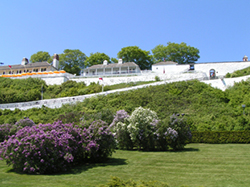
Mackinac Island
One of Michigan's most historic places, Mackinac Island features hundreds of years history in its many sites, museums and streets. The jewel in the crown is Fort Mackinac and other sites managed by Mackinac State Historic Parks. In addition, Historic Downtown Mackinac features many historic buildings including the Biddle House, the Benjamin Blacksmith Shop, McGulpin House, American Fur Company Store & Dr. Beaumont Museum, and Mission Church. The island also has the oldest catholic parish in Michigan, Ste. Anne's which was founded in 1743. In 1875, most of the island was designated, "Mackinac National Park," U.S.'s second national park, by the federal government until these lands were given to Michigan in 1895, creating Mackinac Island State Park.
Learn More
- Visit the Mackinac Parks website.
- Visit the Ste. Anne Catholic Church website.
- View on Google Maps